The production system for AI filmmaking.
You are paying for the same shot four to six times. Forge reads the script, breaks it into scenes, holds every character to a dossier, and boards every shot. Each board frame animates into the rendered shot you will actually use.
- Plans
- From $49 a person or $139 a project
- Generation
- Provider list price plus a published margin, by plan
- Models
- Every major image and video model, one pipeline
- First two weeks
- Free to build. Top up only when you generate

 10,000+ frames and 1,000+ shots generated in the closed beta
Move the takes slider. That is the whole argument.
Published provider rates, margin included. Change how many takes it costs you to land one final shot and watch the total.
Teams without a continuity spine report four to six. With dossiers bound to every frame, productions in our beta sit nearer one and a half.
Hold continuity at 1.5 takes and the same picture costs $0. Difference: $0.
Enter a valid email address.
Providers' own published list prices, read November 2026, with the plan margin included, with the same twelve percent margin on every plan. Board stills costed at an average 2K image rate. Failed generations are not billed. An estimate for budgeting, not a quote. Plan fees are separate and listed below.
Why the takes slider is the whole argument
Every generator can produce a beautiful ten seconds. None of them can produce the same face twice on purpose. So your team rerolls, and rerolls again, because the jacket changed colour between shot four and shot nine and nobody caught it until the assembly. You pay the provider for every take, including the five that never reach the board.
Character consistency out of ten across a multi stage video pipeline, with and without a visual anchor on each generation. A 93 percent collapse.
Published 2026 analysis of multi shot AI video pipelines. Forge did not run the study. We built around the finding.
Weeks of pre-production on mid budget pictures, before and after AI script breakdown feeds complexity, locations and scheduling into the budget.
2026 industry reporting. Market context, not a Forge result.
Left, the production. Right, the picture.
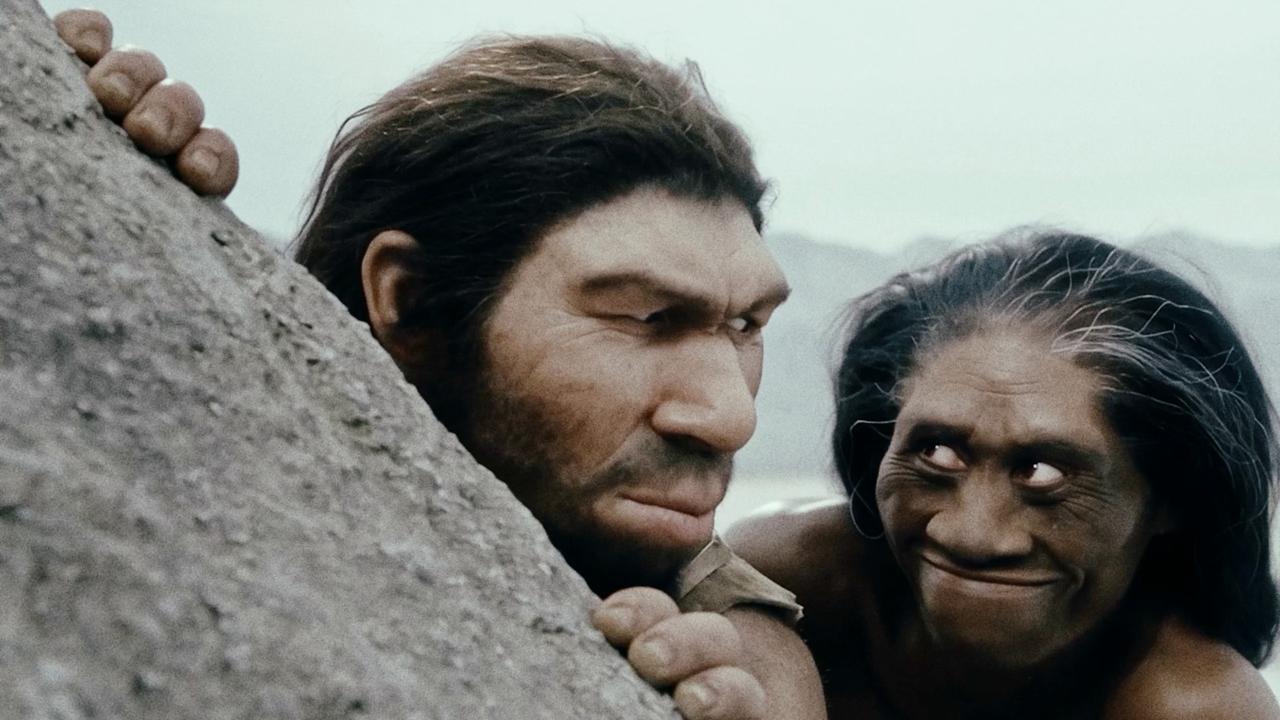
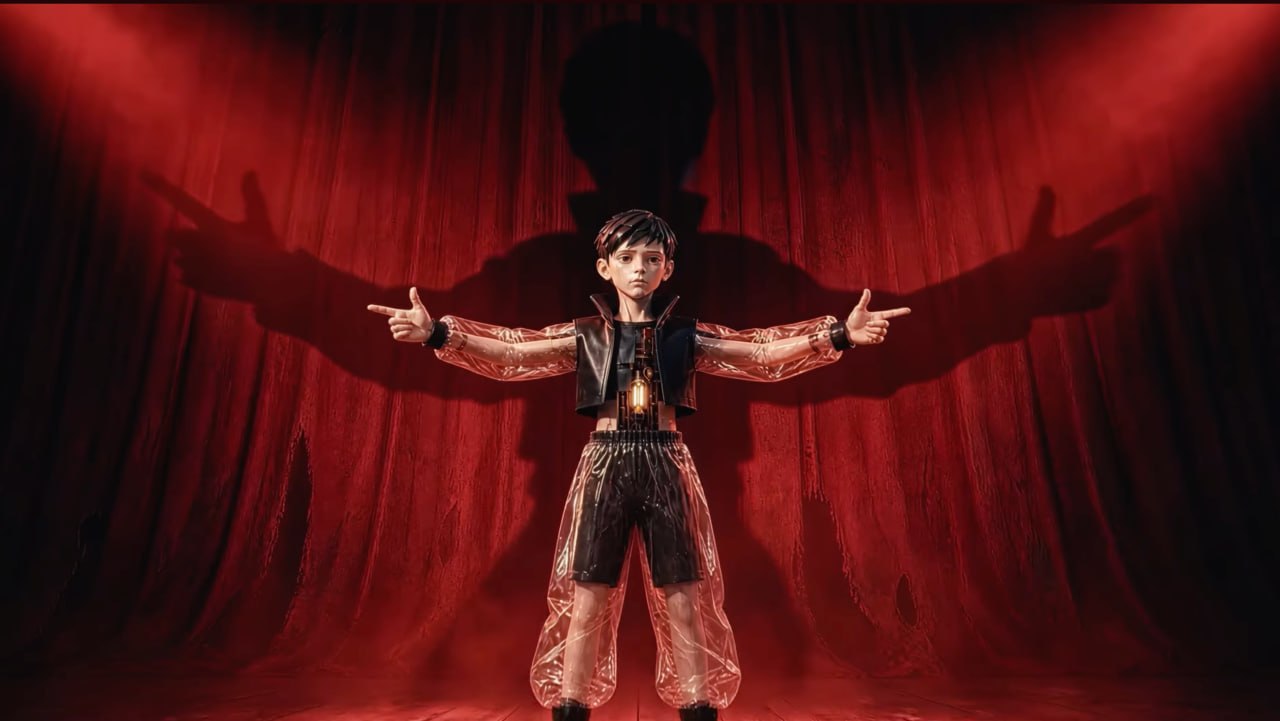
On the left, this picture as the crew sees it in Forge: scene one on the board, thirty four numbered frames, each with its storyboard, its rendered take and its approval. On the right, the opening sequence that board became, made entirely in Forge.
Forge projects
A series and two films made with Forge. Explore the projects and their latest status.

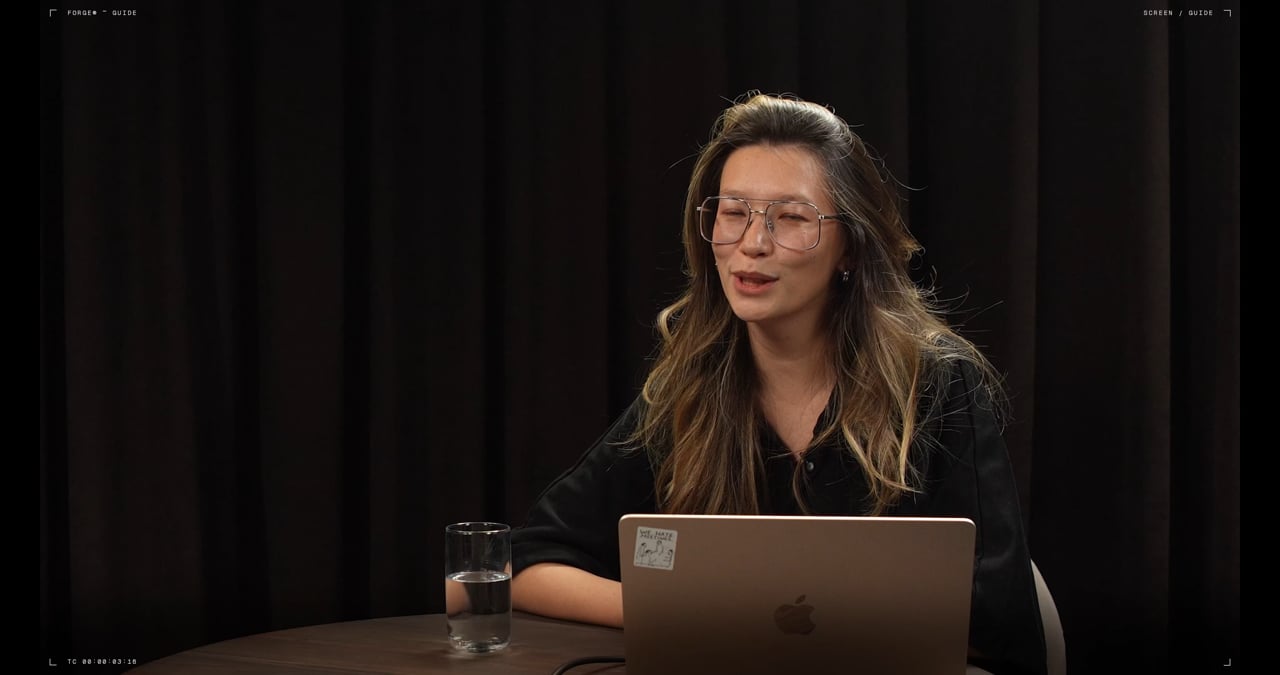
See Forge in action
A guided look inside Forge, from the team at Red Pepper Film.
Two generations. Same boy. Same forest. Same film.
Different takes, generated at different times, in different sessions. Nobody prompted the freckles back into place.
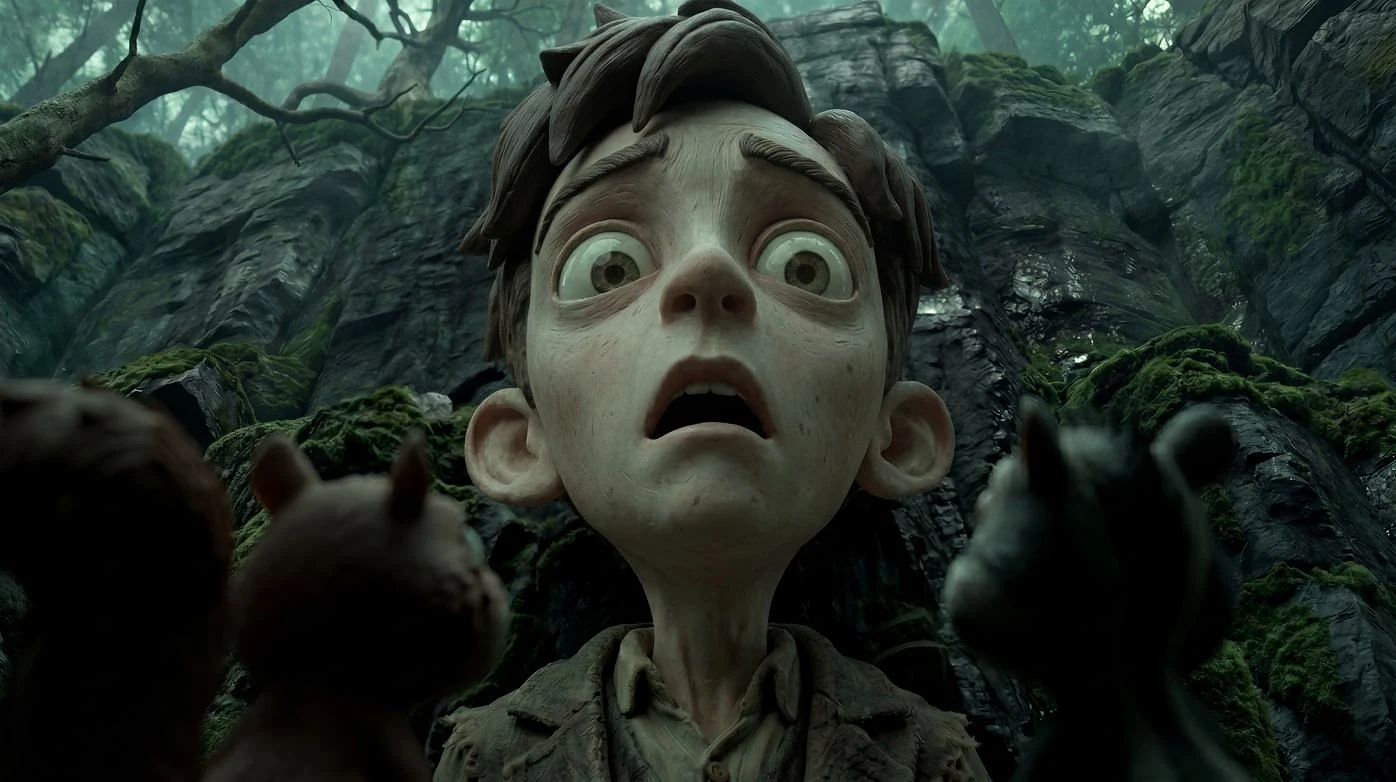
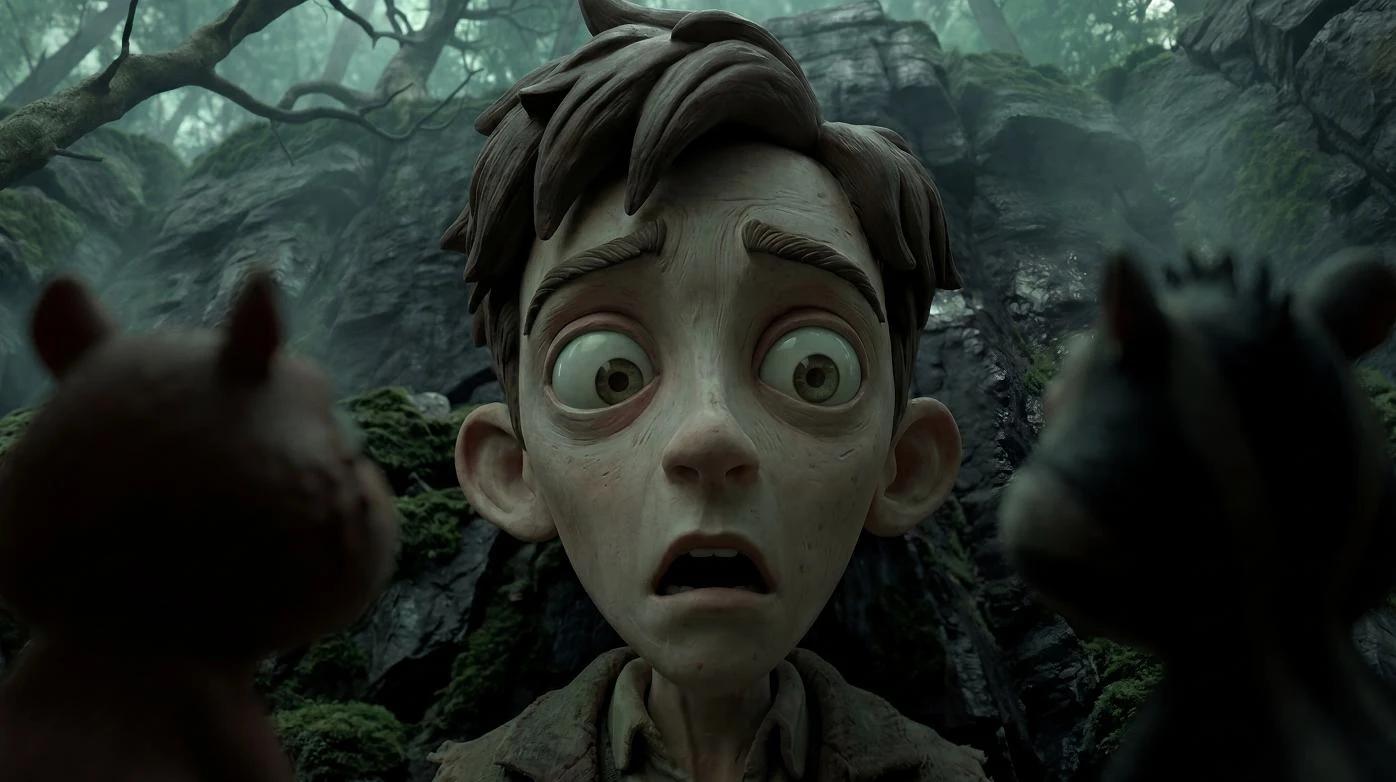
Frames from a feature in the Forge closed beta. Shown with the production's permission.
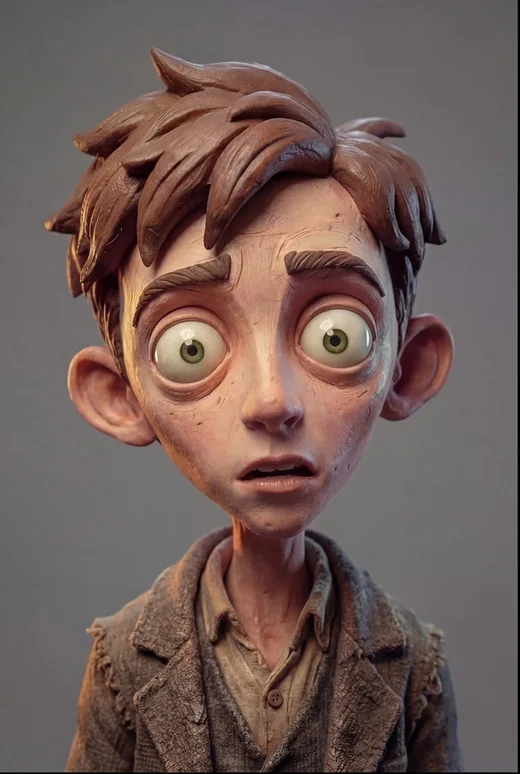 Normal
 Sad
 Crying
 Sc. 13 full
 Sc. 15 full
A character is an entity, not a prompt
It carries a handle, a reference set, an emotion range, a wardrobe note and the scenes it appears in. Every frame that tags @theodore inherits all of it, in scene 13 and again in scene 18, whichever model renders it. Locations, props and costumes work the same way.
That is the difference between footage and a film
A film is a thousand decisions held consistent across months, departments and revisions. Nothing in a prompt box holds a decision for a thousand shots. A project bible does, and it outlives every prompt and every model release.
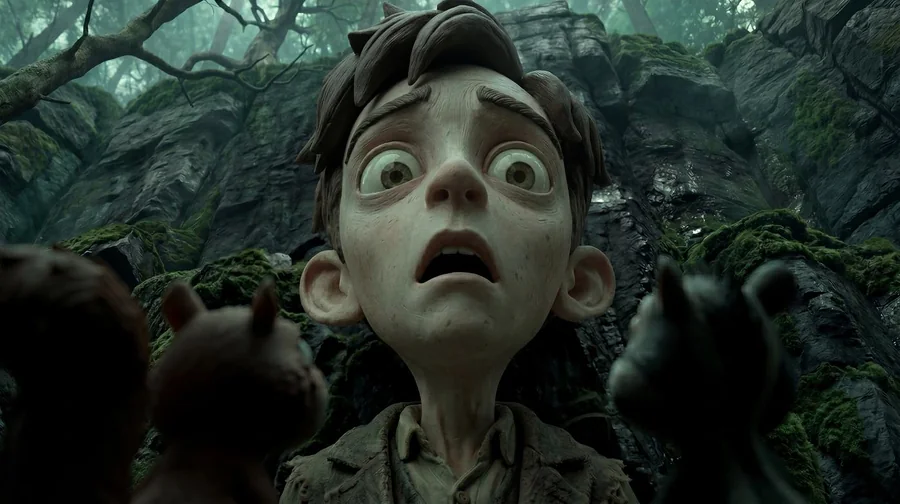

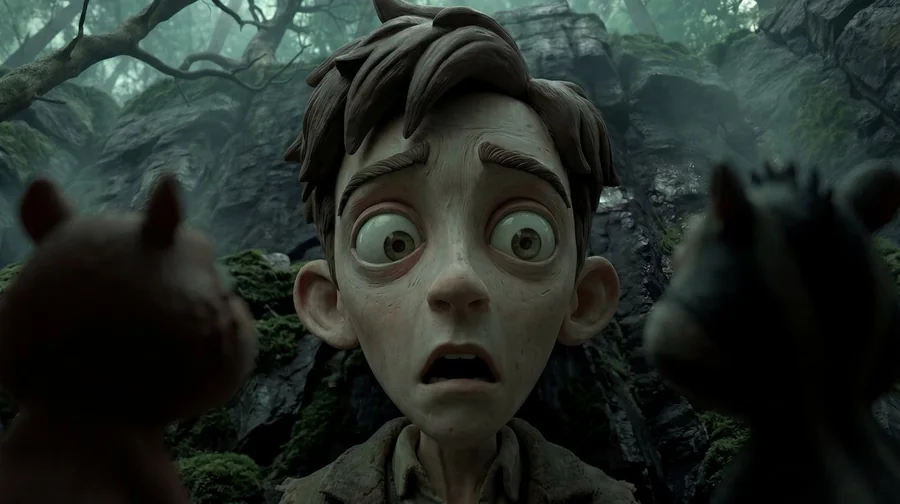


“We stopped arguing about which version of the boy was the right one. The dossier settled it, and the boards stayed settled. That alone paid for the system on the first picture.”
“Our line producer opened the breakdown in Excel and did not ask a single question. That is the whole review. Everything else in this market makes pictures. This makes a production.”
Nothing gets described to the machine twice.
Attach the script. Forge reads it, proposes the cast and the locations, and you confirm. From there every department works off the same spine.
Everything the film is made of
Characters, locations, props, costumes and makeup, each with galleries and folders. The producer invites the crew by email and decides who can do what.
- Every entity gets a unique @handle you tag into any shot
- Script lives in the project as PDF, DOCX or TXT
- Scene breakdown imports from XLSX or gets built by hand
- Moodboard and project style set once, applied everywhere
Generate, then place it in the film
An infinite node canvas where prompts and references flow into a model, and the result flows straight into a numbered shot of a numbered scene.
- Model agnostic. New models plug in through an adapter
- Jobs run async. The canvas never blocks
- Full history per frame: model, prompt, author, date, cost
- Every board frame animates into a rendered video shot
Designed in, shipping next
Compositing, masking and assembly already sit in the architecture and land after the first release. We would rather ship the pipeline solid than the demo wide.
- Node compositor, painter, channel and blur tools
- Mask extraction, mask by text, matte grow and shrink
- Sequence assembly and export
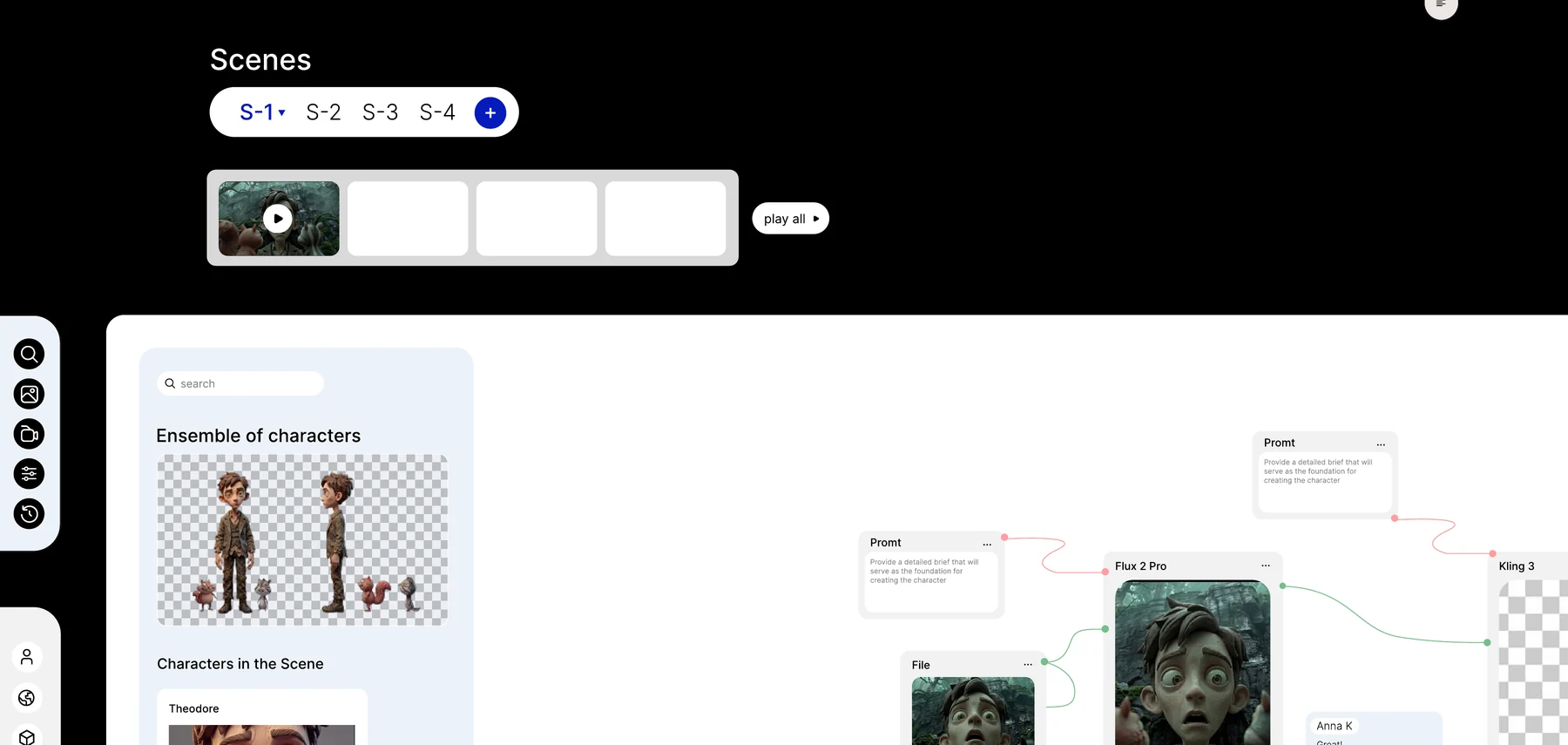
Prompt and reference nodes wire into whichever model suits the shot, and the result lands in a numbered frame of a numbered scene.
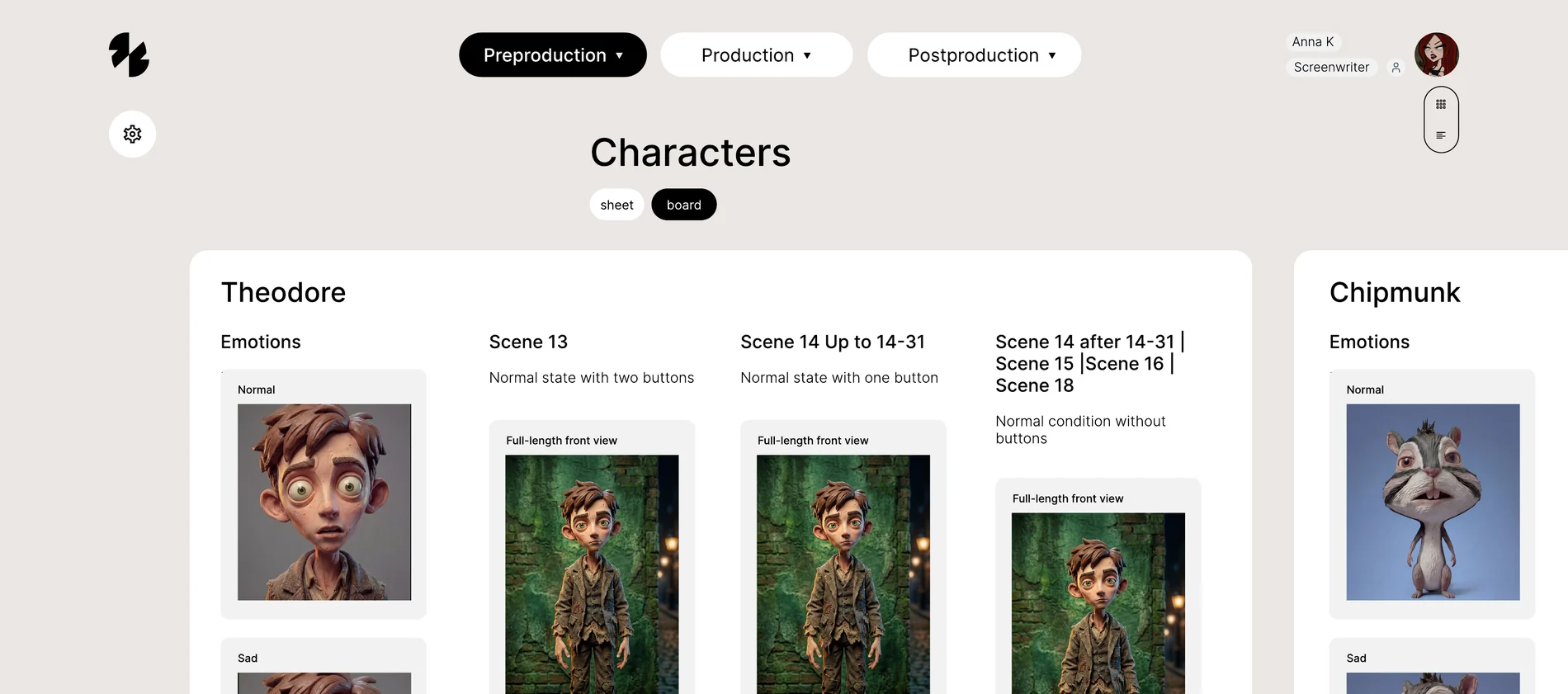
One row per character, one column per scene state, every image attached to the handle the shots tag.
Directors think in frames. Producers think in rows.
Both are the same data. Change either one and the scene updates. The row view is the table a production actually runs on: frame size, still brief, animation brief, location and sub location, timing, day, interior or exterior, script day, synopsis, cast, makeup and wardrobe, props and picture vehicles.
The cast column is where the handles live
@tony, @lila, @tourguide, @passengers. Tag an entity into a row and every frame generated from that row inherits the dossier. That is why the boards stay true across a hundred revisions.
Export the breakdown back to XLSX when the boards are locked, so it slots into the scheduling and accounting tools your line producer already uses.

Scroll sideways and it keeps going. This is a real breakdown, not a feature list.
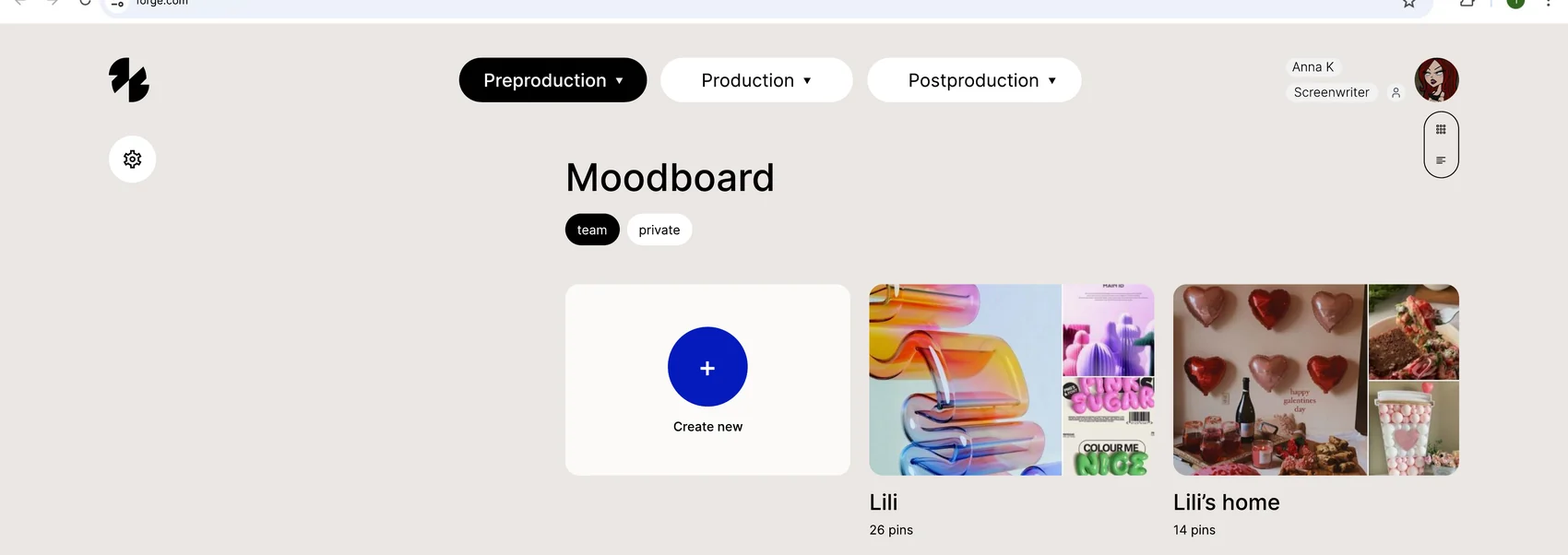
Visual research, links and notes live in the project, not in somebody's desktop folder.
One adapter. Every model worth running.
Image and video models sit behind a single adapter layer, so a better model next quarter is a catalogue entry rather than a migration. The model that nails a dialogue close up is not the one that holds a crowd wide together. On the canvas you pick per node, see the estimate before you run it, and the frame records which model made the take and what it cost.
- Seedance 2.5
- Seedance 2.0 Pro, Fast, Mini
- Kling 4.0, 3.0, O3
- Veo 3.1, Omni Veo
- Grok Imagine 1.5
- Nano Banana 2 Pro, 2 Lite, 2.1
- GPT Image 2.6 Flare, Sunburst
- GPT Image 2.5, 2
- Seedream 5.0 Pro, 5
- Ideogram 4.5
- Script: PDF, DOCX, TXT
- Breakdown: XLSX
- Reference images, video
- Moodboard links, files
- Rendered shots
- Animatic per scene
- Breakdown: XLSX
- Boards, shot list
- Provenance record
The tools your office already runs
Breakdowns move in and out as XLSX, so the schedule and the cost report stay where your line producer and accountant already work. Scripts go in as PDF, DOCX or TXT with no conversion step.
Your edit bay
Board frames animate into rendered video shots and download as standard files, scene by scene or as a full animatic, ready to drop on a timeline in whatever your editor cuts in.
Direct conform and round trip
Timeline interchange into the finishing suite, and a scheduling format that drops straight into the tools your production office already runs. Tell us which ones matter on your picture and they move up the list.
Ten seconds is content. Ten minutes is cinema.
Most AI video tools optimise for the single viral output: presets, effects, a community feed. That work is real and it is not filmmaking. We build for the other job.
| Tools built for clips | Forge Cinema | |
|---|---|---|
| Unit of work | One clip | One picture. Scenes, shots and the whole schedule |
| Memory | Your last prompt | A project bible that outlives every prompt and every model |
| Continuity | Reroll until it roughly matches | @handles bind a character, location, prop or costume to every frame it appears in |
| Adding your crew | Another seat, another licence | Paid seats for the people who generate. Unlimited free viewers for everyone who reviews |
| Proving rights | A download with no history | Model, prompt, author, date, cost, references and licence recorded per frame |
| What you leave with | A file in a downloads folder | Rendered shots for the edit, a breakdown export, boards and a shot list |
The IP is yours. Every frame can prove it.
Your script, your dossiers, your boards and every rendered shot are your intellectual property. Forge takes no licence to any of it and trains nothing on it. The question a studio's legal department asks next is not whether the shot looks good. It is who made it, with what, from which references, under whose licence, and can you show that in two years when the distributor's errors and omissions insurer asks. Forge logs that on every frame, from the first board still to the final rendered shot.
An illustration of the record Forge keeps. Export the full set for a production as an appendix for your counsel. Forge records the facts. Clearance is your lawyer's call, and this is the document they ask for.
Who owns the IP
You do. Script, dossiers, boards, animatics and rendered shots are yours, with no licence back to Forge, no training on your material and no public feed where your work can surface. And because every frame carries a record, you can show it.
- Every frame records model, prompt, author, date, cost and the entities it used
- Every reference is traced to a file in your project
- The provider's commercial terms in force at generation are recorded with the frame
- Export the whole record for a production as a chain of title appendix
- Approval history shows who signed off each shot and when
- At wrap, everything exports: breakdown, boards, shots, animatics and the record. The project stays in your account
An unreleased script is the most valuable file you own
Material is scoped to its project. Only people the producer invited to that project can open it. There is no shared library and no discovery surface anywhere in the product.
- Project scoped access, granted by the producer alone
- Enterprise identity requirements, including SSO and SCIM, are scoped during onboarding and require an agreed integration; they are not self-service features
- HTTPS only, passwords salted and hashed, login attempts rate limited
- Uploads validated by type and size, executables rejected
- Sign ins, generation jobs and balance operations all logged
- Daily database backups with fourteen day retention
- Working toward TPN alignment at the request of a beta production
A plan for the project. Generation at the provider's price plus a published margin.
The plan covers the system: seats, storage, script pages and the Forge assistant. Generation is separate and transparent. Every dollar you add is a dollar of balance, spent at the model provider's published rate plus a twelve percent margin on every plan. Nobody sells you credits, nobody hides the rate, nobody throttles you when the month gets expensive.
Every plan: unlimited free viewers, script pages and storage included, a Forge assistant allowance per seat. Beta pricing. Studio and Enterprise terms are set per production; the full plan detail is on the billing page inside the app.
Annual plans are ten months for twelve. Fourteen day project trials do not include paid generation. Top up to generate; included funds arrive after the first payment. Add-ons bill at monthly list price for the selected term.
A project is one script and everything made from it: dossiers, boards, shots, crew. Longer scripts add pages. Large Studio and Enterprise have no page or project limits.
What a minute costs, model by model
Forge on a Large Studio plan, generation at the provider's list price plus twelve percent. Beside it, what the same model costs on the platforms a production is most likely to compare us with, read from their own published numbers in November 2026.
Magnific: 4,400 credits for a 4 second 1080p clip, 1,760 for 720p and 180 for a 2K GPT 2.5 Medium image, on the Plus plan at $45 for 50,000 credits a month, from magnific.com/pricing. Higgsfield: 128 credits for an 8 second 1080p clip and 56 for 720p, on the Plus plan at $49 for 1,000 credits, from Higgsfield's own pricing article of 20 October 2026. Absurd: absurd.com/pricing, top up rate. All read November 2026. The GPT Image Higgsfield figure is Absurd's reading, not ours, and is marked as such.
The row that matters is not the rate. It is the rate times the number of takes it costs you to land one shot.
| Cost of one finished 5 second shot | Takes to land it | Rate per take | Cost per finished shot |
|---|---|---|---|
| Forge Cinema, Large Studiodossiers bound to every frame | 1.5 | $3.19 | $4.78 |
| Magnific, Plus plancredits, reference images, no production spine | 4 | $4.95 | $19.80 |
| Higgsfield, Plus plancredits, reference images, no production spine | 4 | $3.92 | $15.68 |
| Absurd, top up ratecanvas, reference images, no production spine | 4 | $3.30 | $13.20 |
| Runway, Standard planSeedance 2.0 Pro, the 2.5 is not offered | 4 | $3.84 | $15.36 |
Seedance 2.5 at 1080p, one 5 second take. Takes per finished shot: 1.5 is what productions in the Forge beta average with a locked character dossier. Four is the low end of what teams working from reference images alone report to us. Magnific from 4,400 credits per 4 second clip on Plus, Runway from 40 credits a second on Standard. Your own number goes in the calculator above.
How the billing compares
The other two ways this market bills you are credits and seats. Here is what each one does to a production.
| Credit suites | Per seat canvases | Forge Cinema | |
|---|---|---|---|
| What a dollar buys | A credit, at a rate the suite sets per model and can change | A dollar of usage, plus the seat | A dollar of balance, spent at the provider's published rate plus a margin you can read on this page |
| Left over at month end | Monthly credits reset | Included usage resets | Balance stays until you spend it |
| A failed generation | Often charged | Not charged | Not charged |
| Putting thirty people on it | Thirty subscriptions, each with its own credits | Thirty seats at forty to a hundred and twenty dollars each, every month | One project plan with the generating seats it needs, and unlimited free viewers |
| The financier, the client, the director | Need a plan to look | A client page, or a seat | Free viewers, as many as you like |
| When the month gets expensive | Queue slows, parallel runs cap | Spend limit pauses generation | You set the project budget. Nothing throttles |
Credit suite and per seat canvas terms as published on their pricing pages, November 2026.
What to tell your financier
The picture is boarded and costed shot by shot before a dollar of generation is spent, and the cost of every frame is checkable against a public price list. Every frame carries a record of who made it, with what, from which references and under which terms, exportable for counsel. The breakdown exports to the scheduling and accounting tools the production already runs.
The system fee is a fixed line. The generation line is a published rate times a shot count you can read off the board.
Have a script and a budget, but no crew? We make the picture for you.
Human-directed. Your director, your producer, your calls. Forge brings the system and the hands.
Feature, series, commercial, vertical micro drama. You bring the script and the budget. Forge brings the crew that already runs this system every day: breakdown, boards, generation, continuity, review, delivery. Fixed scope, a quote from the breakdown, and the IP stays yours.
No platform we know of does this. The others sell you a tool and wish you luck. We put the people who built the system on your picture, inside your project, where you can watch every frame land.
- A producer on your project from the first call, inside the project, not in email
- Breakdown, dossiers and boards for every scene, typically inside the first two weeks
- Rendered shots and animatics for approval, scene by scene, with per frame cost visible
- Delivery cut ready, with the full provenance record for your counsel and insurer
- Your IP, your masters, your project. Everything stays in your account at wrap
- The system and generation bill at the published rates on this page. The crew is quoted per picture
- A limited slate. We take on a few pictures at a time so each one gets the people who built the system
What it is good for. A feature or series with a locked script and a financier waiting on boards. A spot that needs twelve shots by Friday. A vertical micro drama season, sixty episodes, one cast held consistent across all of them. A proof of concept to raise the rest of the money.
Bring a picture. That is the whole qualification.
We onboard productions one at a time, with the people who built the system. Teams with a script and a shot count in front of them go first.
- Access before public launch, with your existing project brought across
- Onboarding and a working session with the team that built it
- Direct influence on what ships in the first release
- No newsletter. We write when there is something to open
Before you put a script in it.
How is this different from an AI canvas or whiteboard?
A canvas is where you make images. Forge is where the production lives. The difference shows up in the scene sheet: frame size, still brief, animation brief, location and sub location, timing, day, interior or exterior, script day, synopsis, cast and extras, makeup and wardrobe, props and picture vehicles. That is the document your line producer schedules from and your accountant codes against, and it exports to XLSX so it lands in the tools they already use. If what you need is a shared surface to generate on, a canvas is cheaper. If you need a picture to survive a hundred revisions and an audit, you need the paperwork underneath it.
What counts as one project?
One script and everything made from it: dossiers, boards, shots, animatics and crew. A feature is one project. Plans include 30 or 60 script pages, and longer scripts add pages at list price. Large Studio and Enterprise have no page or project limits. Paid seats are for people who generate; anyone who only reviews is a free viewer, with no limit on how many.
Who owns the IP, and can we prove it?
You do, in full, with no licence back to Forge and no training on your material. Beyond that, every frame carries a record: the model that made it, the prompt, the author, the date, the cost, the entities it used, the references it was built from and the provider's commercial terms in force at that moment. Export the full set for a production as an appendix for counsel. That is the document an errors and omissions insurer or a distributor's legal team asks for, and most tools cannot produce it at all.
Can our IT department run access the way they run everything else?
Project roles and invitations are available today. Enterprise identity requirements, including SSO and SCIM, are scoped during onboarding and require an agreed integration. They are not self-service features.
What happens to our material at wrap, or if we leave?
Everything exports, at any point: the breakdown to XLSX, boards and shot list, rendered shots and animatics, and the full provenance record. At wrap the project stays in your account with everything in it. If you leave, export first and take it with you. Nothing in your project is used for anything except your project.
What happens if a model we depend on gets shut down?
Nothing happens to your project. This is why the adapter layer exists. When Sora was pulled, teams who had built their pipeline on one generator lost the pipeline. Your dossiers, scenes, shots and boards sit in Forge, not in a vendor, and the frames you already made keep their records.
Can my editor and my line producer actually use the output?
That is the point. Board frames animate into rendered video shots and download scene by scene or as a full animatic. The breakdown exports to XLSX so it slots into scheduling and accounting. The board itself is readable by someone who has never opened an AI tool, which matters when that person is writing the cheque.
How much is it, really?
A plan for the system, from $49 a person or $139 a project, and generation on top at the provider's published list price plus a twelve percent margin on every plan. The first fourteen days of a project are free to build; top up when you are ready to generate. Annual plans are ten months for twelve. The calculator is a budgeting estimate. The app shows the current quote for your model, inputs and settings before each run.
Can Forge produce the picture for us instead of us learning the system?
Yes. If you have a script and a budget but no crew for this kind of work, Forge produces it: our producer and team run the breakdown, boards, generation and delivery inside a project you can open at any time. The system and generation bill at the rates on this page; the crew is quoted per picture after we have read the script. Features, series, commercials and vertical micro drama. Use the production request form above.
We are a traditional production, not an AI shop. Is this for us?
Yes, and that is who we build for. The vocabulary in the product is production vocabulary. If your coordinator can run a breakdown, they can run this.
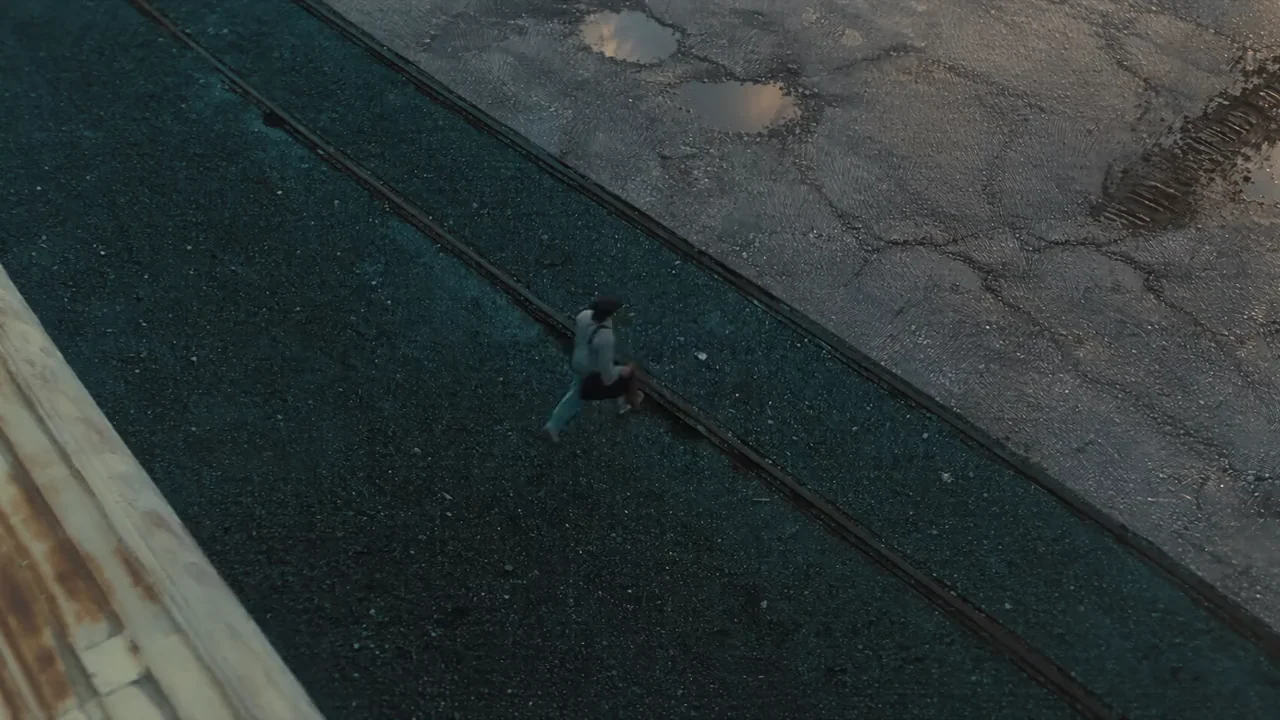
A Forge Cinema production
Your film, held together from the first frame.
Two ways in. Bring your crew and run the system, or bring the script and the budget and we bring the crew.